How to Measure Your Brand’s Visibility in AI
How often does AI mention your brand, and how does it present it? The Heuriso methodology explained: Visibility Score, Share of Voice, sources and answer analysis.
A customer asks AI for a company to handle their bookkeeping, software for their online store or someone to install a heat pump. The answer suggests a few options. Is your brand among them? And if it is, does it come up as the first choice, one of many options or just a passing mention?
Heuriso measures your brand’s visibility in AI by asking a chosen set of questions on a regular schedule, saving the answers and analyzing whether and how your company is presented. The score combines how often your brand is mentioned with the quality of those mentions. Separately, we show your share against competitors and the source links AI provides.
Below we walk through the whole measurement, from choosing the questions to reading the report. The rules and examples describe the Heuriso methodology as of October 26, 2026.
What does AI visibility mean?
AI visibility describes how present a company is in the answers AI generates to users’ questions. In practice, three things are worth checking:
- Presence: does AI mention your company at all?
- Presentation: where in the answer does it appear, and how is it described?
- Context: which other brands and sources appear in the same answer?
The distinction matters. A company can be mentioned often but only in passing. It can also appear rarely, but as a clearly recommended provider. Simply searching for your brand name in the text won’t show that difference.
The measurement covers a specific set of questions and the answers collected for them. It doesn’t give access to every conversation users have with chatbots, or to the number of people who saw a given recommendation.
Step 1. Choose questions that matter to your customers
Monitoring starts with your brand, its domain and a set of questions. A good question reflects a situation in which a potential customer looks for a solution, compares offers or chooses a provider.
For a company that implements CRM systems, examples could be:
- “Which companies implement CRM for small sales teams?”
- “Who can set up a CRM with an online store integration?”
- “Which companies help migrate data between CRM systems?”
The prompts Heuriso generates to measure organic visibility never include the name of the brand being monitored. We check whether it comes up on its own. Keep the same rule when you add or edit a prompt by hand. A question like “Does company X implement CRM?” serves a different purpose: it checks what AI knows about a specific company.
When choosing questions, cover your main services, your customers’ problems, your location (for local businesses) and the stage of the buying decision. Keep the set comparable between measurements. Adding new topics can change the average score even if visibility for the earlier questions stays the same.
Step 2. Collect answers from several AI engines
A standard Heuriso measurement covers ChatGPT, Gemini, Perplexity, Google AI Overviews and Microsoft Copilot. Whether an answer is available can vary between measurements. Questions are sent through each service’s interface in a browser, and the answers are saved for later analysis.
In the report you can go back to the full text of each answer and see what a rating is based on. We also save the links and sources that are available. Their scope depends on the engine and the specific answer.
Prompts are sent from one location, an IP address in Poland. Web search inside AI assistants, and Google AI Overviews most of all, picks the market from the IP address, so answers to broad questions without a location reflect what a user there would see. Prompts that name a city or country are answered for that place.
Automatic monitoring runs on a daily cycle for brands that have finished setup and have active access to the service. Every hour the system checks which brands are due for their next measurement, and it never starts a second job for a brand that is already queued or being measured. That doesn’t mean readings always happen at the same time of day.
Repeating questions lets you see changes that a one-off check can’t. A collected answer is still a sample from a specific moment and session; we don’t assume every user sees exactly the same text.
Step 3. Calculate the Visibility Score
Visibility Score is a score from 0 to 100 that combines how often your brand appears with how well it is presented. It is Heuriso’s own metric, and its rules stay the same from one measurement to the next.
Frequency: in how many answers does your brand appear?
For each prompt and engine, we check what share of the collected answers mentions your company. That share is the mention rate.
If your brand appeared in three of five answers, the mention rate is 60%. Repeating the name several times in one answer doesn’t increase it.
In the Visibility Score calculation, this share covers the most recent samples for a given prompt and engine pair. The “Mentions” column in the prompts table is calculated separately, from the whole history of a prompt and across all engines combined, so it can show a different value.
Quality: how does AI present your company?
An answer that mentions your brand earns points for three things:
| Element | What we check | Points |
|---|---|---|
| Brand position | Where the brand appears in the order of the answer | First: 4; second: 3; third: 2; lower: 1; no clear position: 0 |
| Presentation | Does AI specifically recommend the company, list it as one of several options or just mention it briefly? | Clearly recommended: 3; one of the options: 2; brief mention: 1; not classified: 0 |
| Sentiment | Is the description positive, neutral or negative? | Positive: 3; neutral: 2; negative: 1 |
The maximum quality of a mention is 10 points. If your brand is missing from a successfully collected answer, that sample scores 0. Position refers to the order of brands in the text, not to a page’s position in Google’s search results. Coming first in a plain list doesn’t count as a special recommendation.
A worked example
Say we collected five valid answers for one prompt in one engine. Your brand appeared in three of them, and the average quality of those three mentions was 8/10.
Prompt score = mention rate × average quality / 10 × 100
In this example: 0.60 × 8/10 × 100 = 48 points.
This is a worked example, not a real client’s result. It shows why appearing in 60% of answers doesn’t mean a Visibility Score of 60. How your brand is described counts too.
How the overall score is calculated
First we average the prompt scores within each engine. Then we combine the engine scores with weights: ChatGPT 35%, Gemini 22%, Perplexity 17%, Google AI Overviews 14% and Copilot 12%.
At each level (prompt, engine and overall score), the result is rounded to whole points.
If an engine has no data, the weights of the available engines are scaled up proportionally. These weights are part of the Heuriso methodology; they don’t represent market shares. That’s why it’s worth checking the scores of individual engines and the completeness of the data next to the overall number.
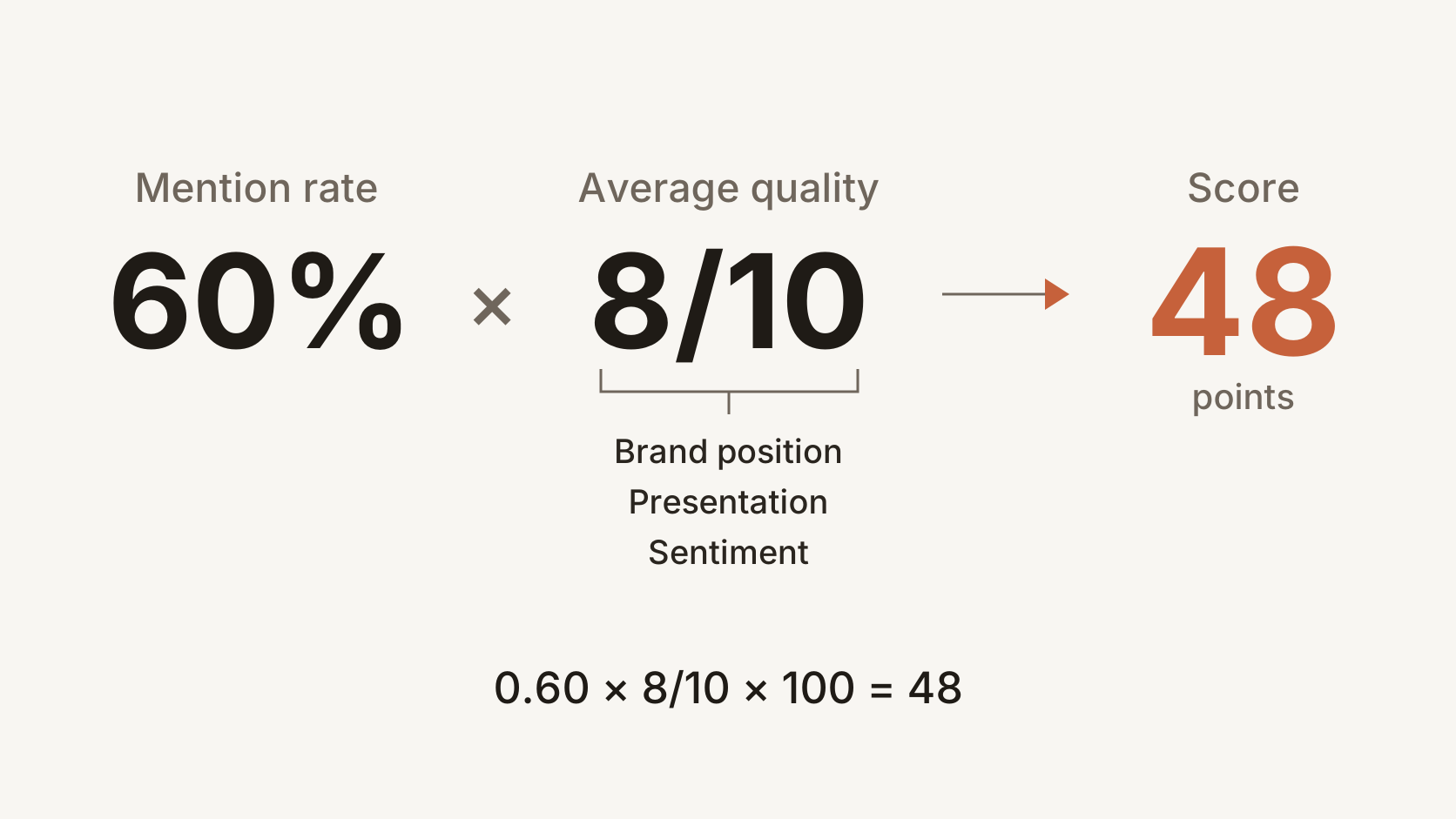
Figure 1. Mention quality is the sum of points for brand position, presentation and sentiment. The average is calculated only from answers that mention the brand. Example for one prompt and engine: 0.60 × 8/10 × 100 = 48 points. This is a worked example, not a real client’s result.
Why we use the last few measurements
For each prompt and engine pair, Heuriso uses up to the five most recent valid samples, none older than 14 days. Once the window holds five samples, each new one replaces the oldest. That way a single unusual answer has less impact on the score than it would in a measurement based only on the latest reading.
At the start there is less data. When the average number of samples per prompt and engine pair, averaged across engines with data, is below three, the score is marked as preliminary. With a single answer, a brand is either present or absent, so the mention rate has very low resolution.
A failed fetch or analysis isn’t proof that AI left your brand out. Failed readings, empty answers and searches where Google showed no AI Overview are excluded from the calculation. A valid, non-empty answer that doesn’t mention your brand, on the other hand, scores zero. So read the trend together with the number of samples and the availability of each engine. You’ll find more about this approach in the AI brand monitoring entry.
Step 4. Compare your brand with competitors using Share of Voice
Visibility Score describes how present your company is and how it’s presented. Share of Voice (SoV) shows its share of the mentions of your brand and the competitors you track.
In the dashboard we calculate it like this:
SoV = mentions of your brand / (mentions of your brand + mentions of tracked competitors) × 100%
For example: your brand appears in 10 answers and competitors collect 30 mentions in total. SoV is 10 / 40 × 100% = 25%. Each company counts at most once per answer, but one answer can name several different companies.
SoV uses the same rule of up to five recent valid samples per prompt and engine, none older than 14 days. Every mention carries the same weight here: first place and a brief mention at the end add to the count equally.
The set of prompts can differ from the one behind Visibility Score after you stop tracking a prompt: its past answers can still affect SoV while they remain within the time window. When there are no mentions of your brand or any tracked competitor, the dashboard shows 0%, because there is nothing to compare.
SoV can drop even if the number of mentions of your brand stays the same, if AI starts mentioning competitors more often. Conversely, excluding a company from the comparison can raise your share without any real improvement in visibility. That’s why you should compare results with the same competitor list.
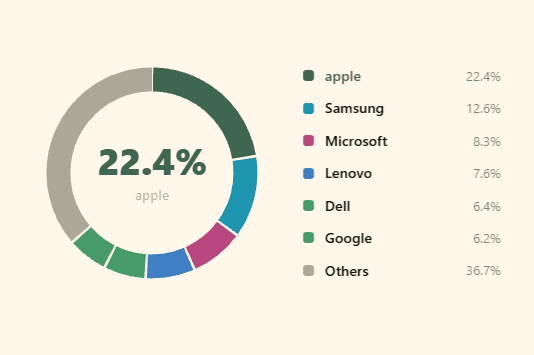
Figure 2. The Share of Voice view in Heuriso: Apple holds 22.4% of mentions in this comparison. The other segments show the shares of competitors and other brands.
Step 5. Check the sources and the answers themselves
The report lets you go from a number to the actual answers. Check which questions mention your brand, who AI names alongside it and which pages the available citations lead to.
A mention of your company and a link to its website are two different signals. AI can name a brand without giving its address, or use content from a domain without recommending its owner. A citation alone doesn’t add points to Visibility Score.
Heuriso also keeps visibility separate from the accuracy of information about your company. Claims from answers to control questions about your brand are compared with information from its official website and the facts saved in your company profile. That way you can catch information mismatches. This separate stream doesn’t affect Visibility Score or SoV.
Automated analysis can need a human check. Go back to the quote and the source material, especially when an answer is ambiguous or your company’s details have changed.
How to use the report for SEO and GEO work
Start with business-critical questions where your company doesn’t appear or is described only briefly. Read the answers and work out what information the potential customer was looking for. Only then decide what to change on your website or in your brand’s messaging.
A practical way to work with the report:
- Pick a topic. For example, a service where competitors keep showing up.
- Check your own content. Does it explain the scope of the service, who it’s for, the terms and specific use cases?
- Review the available sources. Is the information about your company consistent and up to date?
- Make a change and note the date. It could be clarifying your offer, describing an implementation or answering an important customer question.
- Watch the next measurements. Compare a similar set of prompts, engines and competitors. A rise after publication doesn’t on its own prove that the change caused it.
This approach supports GEO, or generative engine optimization, and it also brings order to your content work. Google says the fundamentals of SEO still apply to AI Overviews and AI Mode; it doesn’t require special files or a separate schema markup for these features. See Google’s official guidance on AI features.
Above all, content should help the reader: answer their question, add real knowledge and present reliable information. That’s also the direction described in Google’s guidance on helpful content.
Frequently asked questions
Does a Visibility Score of 70 mean my brand appears in 70% of answers?
No. The score combines mention frequency, mention quality and engine weights. The share of answers that mention your brand is the mention rate. Visibility Score also isn’t the percentage of AI users your company reaches.
Does Heuriso show every AI answer about my brand?
Heuriso analyzes the answers collected for the prompts tracked in your project. The score depends on that scope. It doesn’t cover every conversation people have with chatbots.
How soon can I judge the trend?
The first answers show your starting point. For a comparison, collect several cycles, check that the data is complete and wait for the window of up to five samples to fill for the prompt and engine pairs you track. How fast that happens depends on the schedule and on successful readings.
Does a higher score guarantee more sales?
The score describes the AI answers that were analyzed. To judge business results, you also need data on visits, inquiries and conversions. Monitoring helps you choose where to work and track changes in your brand’s presence.
How do I start tracking my brand?
Add your brand and domain, choose prompts that reflect your customers’ needs, and once the results come in, review the answers and the competition. You’ll find the available plans on Heuriso’s pricing page.
Want to know whether AI recommends your company? Heuriso measures it daily across five engines.
Try it for 7 days